Key takeaways
- Condensing water from air is a real process — the same physics used by atmospheric water generators.
- A typical dehumidifier is not a drinking-water appliance. Stagnant condensate can support mold and bacteria, and water can pick up metal residues from parts, as Stanford magazine has summarized from EPA material on condensate.
- Boiling kills many microbes but does not remove metals or most chemicals. That is why public emergency guidance treats boiling and bleach as microbial treatments, not as complete purification.
- If you need backup drinking water, start with stored water following CDC and Ready.gov advice — not a dehumidifier bucket.
How dehumidifier water forms
A compressor dehumidifier works much like a small air conditioner. A fan pulls room air across a cold coil. If that coil is at or below the air’s dew point — the temperature at which the air becomes saturated, as defined by the US National Weather Service — water vapor condenses into liquid and drips into a tank or drain hose.
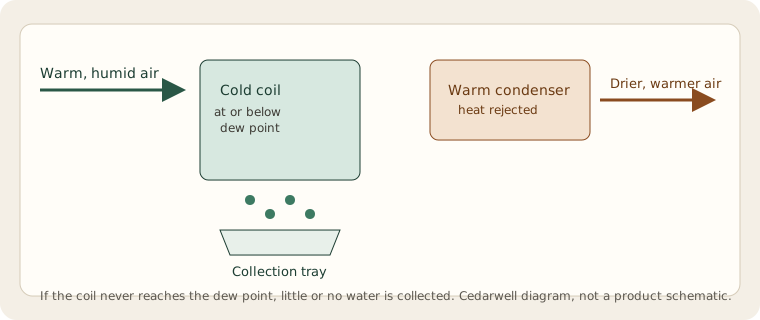
Joe Schwarcz, writing for McGill University’s Office for Science and Society, explained the appealing part of the chemistry: when water evaporates into air, it leaves many dissolved impurities behind, so freshly condensed droplets can be comparable to distilled water — if they form on a clean surface and are collected cleanly. The problem is everything that happens after that first droplet forms.
That is why “it came from air, so it must be pure” is an incomplete story. Purity at the moment of condensation is not the same as purity in a tank that has been sitting in a dusty room.
Why it is not treated as drinking water
Household dehumidifiers are built to remove moisture and to be emptied or drained. They are not certified as drinking-water systems. Several independent explainers make the same practical points:
- The tank is a standing-water reservoir. The US Environmental Protection Agency has long noted that stagnant condensate can harbor biological contaminants, including mold, mildew, and algae, especially if a collection bucket is not cleaned regularly. Stanford magazine’s “Don’t Drink the Water (From Your Dehumidifier)” summary cites that EPA point directly.
- Parts are not a food-grade water path. The same Stanford piece notes that condensate can contain lead and other metal residues from component parts. Consumer units may use coils, solder, coatings, and plastics chosen for refrigeration duty, not for contact with drinking water.
- Incoming air is not sterile. Room air carries dust, spores, cooking aerosols, and whatever else a living space contains. Those materials can land on the coil and wash into the tank.
- Manufacturer instructions usually say not to drink it. Stanford reproduced a typical manual warning against drinking collected water. If your manual says the same, that is the design intent of the product you own.
McGill’s explainer is slightly more conditional: water that has just dripped from a freshly cleaned coil into a clean vessel would be a different case from water that has sat in a tank. Even there, the conclusion is not to treat a dehumidifier as a drinking fountain. Cedarwell has not sampled tanks, and we are not going to soften that into a DIY protocol we have not validated.
Does boiling or filtering make it safe?
This is the most common follow-up, and Google Autocomplete reflects it: people ask about boiling, filtering, boiling plus filtering, and even using a straw-style filter.
Boiling is the method Ready.gov calls the safest way to treat water of uncertain quality for microbes: bring water to a rolling boil for one full minute. The US EPA’s emergency disinfection page likewise says boiling is sufficient to kill pathogenic bacteria, viruses, and protozoa (citing WHO, 2015), and it adds a longer boil at high altitude: at least one minute, or three minutes above 5,000 feet (1,000 meters). Those pages are written for water that may contain germs — not as a promise that boiling removes everything harmful.
EPA is explicit about the limit that matters here: boiling or disinfection will not destroy other contaminants, such as heavy metals, salts, and most other chemicals. If a coil or tank has contributed metals, or if household chemicals have found their way into the water, a rolling boil will not take them out. In some cases, boiling can even concentrate dissolved substances as water evaporates.
Ordinary filtration is not one thing. A cloth or coffee filter removes visible particles. A certified drinking-water filter is rated for specific contaminants listed on its certification — not for “anything that might be in a dehumidifier.” CDC’s rainwater advice makes the same general point about treatment: choose a method that actually removes the germs or chemicals that are present. Guessing is not a specification.
So “boil it and it is fine” or “run it through a pitcher filter and it is fine” are stronger claims than the official treatment guidance supports. We are not aware of a public-health agency that recommends household dehumidifier tanks as a standard drinking-water source after a home boil.
What if it is an emergency?
Preparedness agencies put stored water first. CDC’s emergency water-supply page, updated 27 June 2025, calls unopened commercially bottled water the safest and most reliable emergency source, and it recommends storing at least one gallon per person per day for three days, with a two-week supply if you can. Ready.gov gives the same per-person daily figure for several days, for drinking and sanitation.
If stored water is gone and you are looking at a dehumidifier tank, that is a last-resort situation, not a plan. Official emergency pages describe treating water of uncertain quality from sources such as unsettled tap water or, in EPA’s additional guidance, melted ice, a drained water heater, or surface water — always with the limits of boiling and bleach in mind, and never as a way to fix water contaminated with fuel or toxic chemicals.
A dehumidifier bucket is not listed in those core how-to pages as a recommended supply. If someone in a true shortage decided to treat condensate, they would still be dealing with an uncharacterized source: possible microbes and possible chemicals or metals. Microbial treatment alone would not address the second group. Cedarwell is not going to write a homemade “make dehumidifier water potable” recipe that official agencies have not published and that we have not tested.
The better emergency move, before a crisis, is to store water on purpose and to know how long that supply remains a sensible reserve.
Safer uses for condensate
Not drinking the water does not mean it has no use, if your manual allows it and you keep it off food-contact surfaces:
- Flushing a toilet when you want to save potable water.
- Cleaning floors or outdoor items you will not eat from.
- Watering ornamental plants. McGill and Stanford both caution against using condensate on edible plants, because of possible biological and chemical residues.
Ironing or steam-cleaning advice appears on some consumer sites; follow your appliance manuals, which may require distilled water for other reasons (scale, not just safety). When in doubt, pour condensate down a drain.
Clean the tank on the schedule your manufacturer gives. That reduces odor and slime. It does not turn the machine into a drinking-water device.
How this differs from an atmospheric water generator
An atmospheric water generator (AWG) also condenses vapor, often with the same refrigeration loop. Commercial units intended for drinking typically add a closed, food-oriented collection path and some combination of filtration, disinfection (for example ultraviolet light), and sometimes remineralization. Those features are part of a designed drinking-water product — and they still need maintenance. They are not magic, and yield and energy use still depend on weather.
A home dehumidifier usually has none of that drinking-water path. A DIY atmospheric water generator sits in between: the physics can work in warm, humid air, but food-safe materials, filtration, testing, and power costs are the builder’s problem, not something a cold coil solves by itself.
Digital DIY guides sold for this kind of project, including the Water Freedom System review on this site, should be read with that distinction in mind. Cedarwell has not built or tested that product. A guide is not a substitute for stored water, and it is not a reason to drink untreated dehumidifier condensate.
Frequently asked questions
Can you drink dehumidifier water if you boil it?
Boiling can kill disease-causing microbes, which is why Ready.gov and EPA recommend it for water of uncertain microbial quality. Boiling does not remove heavy metals or most chemicals, which EPA states clearly on its emergency disinfection page. That is why boiling is not a complete answer for dehumidifier condensate.
Is dehumidifier water the same as distilled water?
Fresh condensate can be similar to distilled water in the sense that many impurities were left behind when the vapor first entered the air. Once the liquid touches coils, dust, and a tank, it is no longer a controlled distillate. Purpose-built distillers also collect steam in a clean path. A dehumidifier tank does not.
Can pets drink dehumidifier water?
Cedarwell is not a veterinary service. The same contamination issues — microbes and possible chemical or metal residues — apply. Use your pet’s usual drinking water, and store extra for them in an emergency (CDC notes that pets can increase how much water you should keep on hand).
Can I use dehumidifier water in a steam iron?
Some consumer articles suggest it because the water is low in minerals. Follow the iron manufacturer’s instructions. “Low mineral” is not the same as “safe to inhale as steam if the tank was dirty.” When the manual asks for distilled water, that is the conservative choice.
Sources
- US National Weather Service, “Dew Point vs Humidity”: weather.gov/arx/why_dewpoint_vs_humidity.
- Joe Schwarcz, “Is water from a dehumidifier drinkable?,” McGill University Office for Science and Society, 20 March 2017: mcgill.ca/oss.
- Stanford Magazine, “Don’t Drink the Water (From Your Dehumidifier),” Essential Answer and Nitty-Gritty, citing EPA comments on stagnant condensate and possible metal residues: stanfordmag.org.
- Ready.gov, “Water,” last updated 22 February 2021, including the one-minute rolling boil and the limits of chlorination versus distillation: ready.gov/water.
- US EPA, “Emergency Disinfection of Drinking Water,” including the statement that boiling or disinfection will not destroy heavy metals, salts, and most other chemicals, and boil times at altitude: epa.gov emergency disinfection.
- CDC, “How to Create an Emergency Water Supply,” 27 June 2025: cdc.gov emergency water supply.
- CDC, “Collecting Rainwater and Your Health: An Overview,” on choosing a treatment that matches the contaminants present: cdc.gov rainwater.