Key takeaways
- CDC: at least one gallon per person per day for three days, and a two-week supply if you can. Ready.gov: at least one gallon per person per day for several days, for drinking and sanitation.
- Unopened commercially bottled water is CDC’s preferred emergency source. If you fill your own jugs, use food-grade containers and follow CDC’s sanitizing steps.
- Do not reuse containers that held bleach, pesticides, or other toxic chemicals. Avoid ordinary milk jugs for long-term storage if they are hard to clean of residues.
- Keep water around 50–70°F (10–21°C), out of sun, away from gasoline, pesticides, and solvents. Replace home-filled water every six months.
- Spread the weight. A few gallons under a bed plus a few in a closet is easier on floors — and on you — than one immovable stack.
How much water fits a small space
The official US numbers are easier to picture in apartment units than in abstract gallons:
| Household | 3-day minimum | 2-week supply | Rough stored weight (3-day / 2-week) |
|---|---|---|---|
| 1 person | 3 gal / 11 L | 14 gal / 53 L | about 25 lb / 117 lb (11 kg / 53 kg) |
| 2 people | 6 gal / 23 L | 28 gal / 106 L | about 50 lb / 233 lb (23 kg / 106 kg) |
| 4 people | 12 gal / 45 L | 56 gal / 212 L | about 100 lb / 467 lb (45 kg / 212 kg) |
A gallon of water weighs about 8.3 pounds (3.8 kg). That is why “just buy a 55-gallon drum” is often the wrong apartment plan: a full 55-gallon drum is on the order of 450 pounds (about 200 kg), plus the drum, and you cannot move it once it is full. Smaller sealed bottles and 1–3 gallon jugs let you split the load.
Ready.gov notes that a normally active person needs about three-quarters of a gallon of fluid a day, but the stored gallon-per-day figure also covers sanitation — brushing teeth, a little washing, cooking. In very hot conditions, water needs can double. Do not plan as if drinking is the only use.
Containers that are actually suitable
CDC says it is best to use FDA-approved food-grade water storage containers, sold at surplus or camping stores, and to ask the manufacturer if you are unsure. Those containers are designed not to transfer toxic substances into the water.
If you cannot get a purpose-made water container, CDC says to choose one with a tight-closing top, made of durable, unbreakable materials (not glass), and, if possible, a narrow neck so you can pour without dipping. Do not use containers that previously held toxic chemicals, such as bleach or pesticides.
Commercially bottled water in original factory-sealed bottles avoids most of those decisions. That is why CDC calls it the safest and most reliable emergency source, and why it is often the best apartment option: you can buy cases, slide them under furniture, and leave the caps untouched until you need them.
Reusable soda bottles are sometimes suggested by local utilities as a budget option because they are food-grade and have tight caps. Whatever you reuse, it must be cleanable. Protein- or fat-residue bottles (classic milk jugs) are a poor long-term choice because they are difficult to sanitize completely and the plastic can become brittle. Cedarwell is repeating a widely used utility caution here, not a unique lab result of our own.
If you fill jugs yourself
CDC’s cleaning steps, in order:
- Wash the container with soap and rinse completely.
- Sanitize with a solution of 1 teaspoon of unscented liquid household chlorine bleach in 1 quart (4 cups) of water, using bleach that contains 5%–9% sodium hypochlorite.
- Cover tightly and shake so the solution touches all inside surfaces.
- Wait at least 30 seconds, then pour the sanitizing solution out.
- Let the empty container air-dry.
- Fill with clean water and close with a tight lid.
Label “drinking water” and the date. Replace that water every six months. See how long stored emergency water lasts for the difference between this rotation and dates on factory-bottled water.
This sanitizing mix is for cleaning the empty container. It is not the same recipe as EPA’s table for disinfecting a gallon of drinking water during an emergency. Keep those jobs separate, and keep the bleach bottle itself out of the same box as your drinking reserve (CDC does want you to store unscented bleach for emergency disinfection — just not leaking onto the water jugs).
Where to put it in an apartment
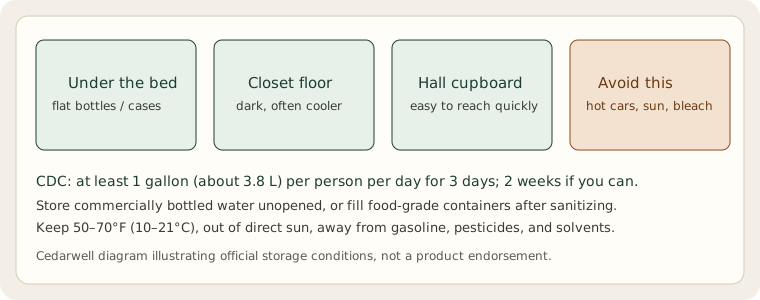
The constraints are temperature (CDC: 50–70°F), darkness, and distance from solvents, fuels, and pesticides. IBWA gives the same idea for bottled water: room temperature or cooler, out of sun, away from paint thinner, gasoline, and similar vapors, because plastic can be slightly permeable.
Practical places that often meet those constraints:
- Under a bed, using cases of bottled water or low-profile containers so the mass is spread across the floor.
- Closet floors, which are usually dark and closer to indoor temperature than a balcony or attic.
- A hall cupboard or entry closet, so some water is available if a room is blocked.
- Behind a sofa or in a rarely used suitcase space, if the area stays cool and dry.
Poor places: a car in summer or a sunny window (heat), an unheated balcony in a hard freeze (burst bottles), and any shelf with household chemicals. If you want a small “go bag” amount, keep a couple of factory-sealed bottles near the door, not your entire reserve in one hallway pile.
Weight, leaks, and neighbors
Spread containers across more than one room so a single leak, a blocked door, or a plumbing failure in one closet does not take the whole supply. Put bottles in a shallow tray or tub if you are over finished floors you do not want stained. Check a new setup after the first week.
Cedarwell cannot inspect your building’s load limits. If you are considering anything much heavier than ordinary boxed groceries in one spot — many cases stacked in a single corner — ask the building manager or a qualified professional rather than assuming a floor will take it. For almost all apartment reserves, several modest stacks are the safer design.
If you cannot store two weeks’ worth
Store what you can, starting with the three-day minimum, and improve the next layer: a way to treat or replace water if the tap is uncertain. Official pages still put bottled or stored water first. Rain barrels and DIY atmospheric water generators do not help in the first hours of a shutoff if they are empty or if the air is dry and cold. They also do not help if you cannot stay in the building.
Know your building’s rules, and know where official information would come from in a boil-water notice. Those local instructions override a general article.
Pets, cooking, and a little washing change the arithmetic quickly. CDC already tells you to consider extra water for pets, for people who are pregnant or ill, and for hot climates. If you share a small apartment with a dog, count the animal in the gallon-per-day planning rather than hoping leftover drinking water will be enough. Keep pet water in the same style of sealed, rotated containers; do not leave an open bowl as your “reserve.”
A small, factory-sealed amount near the door is worth having if you might have to leave. That is not a substitute for the multi-day supply. Ready.gov’s wider kit guidance is about being able to shelter or to go; water is heavy, so a “grab” portion should be bottles you can actually carry, with the bulk reserve stored as described above.
If you rent, check whether the lease or building rules restrict large stored liquids or hallway storage. That is a practical constraint, not a reason to skip preparedness entirely. Cases of bottled water in a closet are ordinary household goods in most buildings. A homemade drum on a balcony may not be.
Frequently asked questions
Is bottled water enough, or should I fill my own jugs?
CDC calls unopened commercially bottled water the safest and most reliable emergency source. Factory-sealed bottles are often the simplest apartment option. Home-filled food-grade containers work if you sanitize, label, store, and rotate them every six months.
Can I keep emergency water in the bathtub?
A tub can be filled after a warning if official advice says to, but an open tub is not a long-term sanitary store. For a standing reserve, use sealed food-grade containers or unopened bottled water.
Where should I store water if my apartment gets hot?
Stay as close as you can to CDC’s 50–70°F range: interior closets, under beds, away from sun and appliances that throw heat. Avoid cars, balconies, and windows. Heat is one of the main quality risks IBWA describes for bottled water.
Do I need a 55-gallon barrel?
Usually no, in an apartment. The volume may look efficient, but the weight is hard to place and impossible to move when full. Several smaller containers add up to the same gallon count and are easier to rotate.
Sources
- CDC, “How to Create an Emergency Water Supply,” 27 June 2025, including amounts, food-grade containers, sanitizing steps, and storage conditions: cdc.gov emergency water supply.
- Ready.gov, “Water,” last updated 22 February 2021: ready.gov/water.
- International Bottled Water Association, “Bottled Water Storage”: bottledwater.org/bottled-water-storage.