Key takeaways
- CDC’s overview (page updated in 2026) is direct: rainwater is not necessarily safe to drink without first removing germs and chemicals.
- CDC prefers public tap water or bottled water for drinking, cooking, brushing teeth, rinsing produce, and watering plants you plan to eat, when those sources are available.
- A serious drinking-water system is more than a barrel on a downspout: clean catchment materials, screens, a first-flush diverter, a sealed tank, then treatment and testing matched to the risks.
- Boiling helps with microbes but not with metals such as lead or copper that can leach from roofs and plumbing.
- Collection is not legal everywhere. Check local rules. Keep rainwater physically separate from piped drinking water.
What CDC says, plainly
The US Centers for Disease Control and Prevention’s page “Collecting Rainwater and Your Health: An Overview” states that rainwater is not necessarily safe to drink without first removing germs and chemicals. If you drink, cook, or bathe with rainwater, CDC says to test it regularly and to ask your health department what to test for. Treatment has to target the contaminants that are actually present — a filter is not a universal solvent.
CDC also recommends limiting uses that involve swallowing rainwater when you can. Suggested lower-risk uses include watering plants you do not eat and washing items you do not use for cooking or eating. If possible, use public tap water or bottled water for drinking, cooking, brushing teeth, rinsing fruits or vegetables, and watering plants you plan to eat.
That is a more cautious stance than “just boil rooftop water and it is fine,” and it is the starting point this article will not talk past.
How rainwater picks up germs and chemicals
CDC describes two stages of contamination:
- In the air, before the drop hits your roof. Dust, smoke, and other particles can contaminate rain.
- On surfaces after it falls. Chemicals such as asbestos, lead, or copper can come from roofing, gutters, piping, storage materials, and other surfaces. Dirt and germs wash in too. Bird droppings on a roof are a clear example, and CDC notes this is especially likely when rain follows several dry days.
Your risk, CDC says, depends on where you live, how often it rains (more frequent rain often means a cleaner catchment, typically), the season, how you collect and store the water, how you use it, and whether you are at higher risk from germs and chemicals in water.
CDC also warns against mixing untreated rainwater into water that has already been treated, such as bottled water or public tap water. The rainwater can contaminate the safer supply. If you have both piped water and rainwater, rainwater must not be able to flow back into the drinking-water pipes.
What a safer collection system looks like
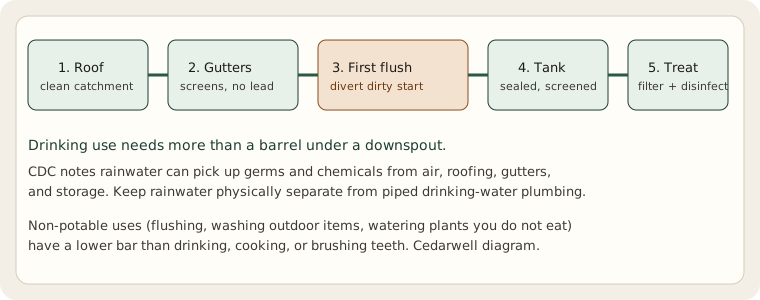
University extension and health-department publications aimed at people who do rely on rainwater for domestic use (for example Arizona Cooperative Extension’s “Preparing Rainwater for Potable Use,” Texas A&M AgriLife, and Hawaii’s Safe Drinking Water Branch) describe a similar chain:
- A catchment surface and plumbing chosen to limit lead, copper, and other leachable materials.
- Gutter screens to keep leaves and animals out.
- A first-flush diverter, which CDC itself highlights: it sends the first, dirtiest runoff of a storm away from the tank. The volume to divert depends on roof size.
- A sealed, opaque or otherwise protected tank with screening, so mosquitoes cannot breed. CDC says to add a screen where water enters, or empty a rain barrel at least every 10 days, and to use a screen to keep out bugs and debris.
- Regular cleaning and repair. CDC lists keeping the system clean, fixing broken parts, and regularly emptying rain barrels as maintenance.
- Then filtration and disinfection, plus testing, if the water is for drinking or bathing.
Hawaii’s Department of Health, for household catchment that is not regulated like a public water system, has published screening levels for turbidity, E. coli, lead, and copper after treatment, and it points owners to certified labs and to University of Hawaii catchment guidelines. Those numbers are Hawaii’s published screening values, not a worldwide drinking-water standard we are inventing. They illustrate the idea: if you drink rainwater, you take on testing, not just a good feeling about “natural” water.
Treatment: boiling is not the whole job
People often ask whether rainwater is safe after boiling, or “if it never hits the ground.” Water that only touched a clean, inert surface in clean air would be a different case than water that ran across an asphalt shingle past a chimney and a gutter seam. In a real roof system, boiling is only a microbial step.
Ready.gov calls boiling the safest household method for killing microbes in water of uncertain quality: a one-minute rolling boil. EPA says boiling kills pathogenic bacteria, viruses, and protozoa, with a longer boil above 5,000 feet, and it states that boiling or disinfection will not destroy heavy metals, salts, and most other chemicals. Lead or copper from a roof or solder is exactly that kind of problem. A carbon filter, a certified treatment device, or a different catchment material may be needed — and CDC says to pick treatment that matches the contaminant.
Do not combine rainwater with a stored emergency bottled-water supply. Keep them separate, as CDC advises.
Notes for the UK, Australia, and Canada
Official tone varies. NSW Health in Australia has published guidance that a properly maintained rainwater tank can provide good-quality drinking water for most users when the catchment is well kept and the water is clear, with little taste or smell — while also warning that people with weakened immune systems need extra caution, and that surface water or bore water should not be used to top up tanks without treatment. That is a more permissive starting point than CDC’s “use tap or bottled water for drinking if you can,” but it still hangs on maintenance and on who is drinking.
UK and Canadian readers should use their local public-health or drinking-water authority, not a US factsheet alone. Building regulations, water-fitting rules (to prevent backflow into a mains supply), and planning rules for tanks can be as important as microbiology. Cedarwell is not providing jurisdiction-specific legal advice.
Is it legal to collect rainwater?
CDC states that collecting rainwater is not allowed in all places, and that some US states have treated rainwater as regulated property. The page points people to the US Department of Energy Alternative Water Supply Tool and to environmental quality or health departments. Rules also change. Do not rely on a social-media list of “legal in every state.”
Even where collection is allowed, using rainwater inside a home that also has a public water connection often requires backflow prevention so rainwater cannot enter the potable pipes. That is a plumbing safety issue, not a paperwork nicety.
Mosquito control is a health issue, not only a comfort issue. CDC’s rainwater page says to screen the inlet or empty a rain barrel at least every 10 days so mosquitoes cannot lay eggs. An open barrel in a warm climate can become a breeding site quickly. A drinking-water tank should be sealed and screened as a matter of course.
First-flush volume is a design choice, not a single universal number. CDC says the amount to divert depends on the size of the roof. Extension guides discuss rules of thumb based on catchment area and on how dirty the roof is after a dry spell; use a published local guide rather than inventing a volume. After a long dry period, the first runoff is especially dirty, which is exactly the situation CDC flags for bird droppings washing off a roof.
For household emergency planning, stored municipal or bottled water remains the first layer in our emergency options comparison and in small-space storage. Rainwater can be a valuable complement where it is legal and well built. It is not an automatic drinking fountain from the sky.
Frequently asked questions
Is rainwater safe to drink if you boil it?
Boiling can kill disease-causing microbes if you follow official boil times. It does not remove lead, copper, or most other chemicals that CDC lists as possible contaminants from roofs, gutters, and pipes. Treatment has to match the risk.
Is rainwater safe to drink before it hits the ground?
CDC notes that rain can already pick up dust, smoke, and other particles in the air. “Before it hits the ground” also usually still means it hit a roof or tarp. Neither is a guarantee of drinking-water quality.
Can I drink rainwater in the UK or Australia?
Follow local health guidance, not only US CDC pages. NSW Health, for example, discusses well-maintained tanks as a possible drinking source for most people, with caveats. UK readers should check current Drinking Water Inspectorate or local authority advice and plumbing rules.
Does a first-flush diverter make rainwater potable?
No. CDC recommends first-flush devices because they divert the dirtiest first runoff. They improve quality. They do not replace filtration, disinfection, or testing if you intend to drink the water.
Sources
- CDC, “Collecting Rainwater and Your Health: An Overview,” updated 2026 (published 16 September 2024; also carries a 16 July 2024 update line on the live page): cdc.gov rainwater overview.
- Ready.gov, “Water,” last updated 22 February 2021 (boiling as a microbial treatment): ready.gov/water.
- US EPA, “Emergency Disinfection of Drinking Water,” including the limit that boiling and disinfection do not remove heavy metals and most chemicals: epa.gov emergency disinfection.
- Arizona Cooperative Extension, “Preparing Rainwater for Potable Use,” AZ1863, 2021: extension.arizona.edu PDF.
- Hawaii Department of Health, Safe Drinking Water Branch, “Rainwater Catchment,” including published screening levels and links to University of Hawaii guidelines: health.hawaii.gov/sdwb.
- NSW Health, “Managing rainwater tanks for safe drinking water”: health.nsw.gov.au.