Key takeaways
- Most homemade units cool a surface below the dew point, like a dehumidifier. If the coil never reaches the dew point, output collapses.
- Peltier (thermoelectric) builds are simple and usually low-yield. Converting or imitating a compressor dehumidifier can move more air and more water — and more electricity.
- Energy use for refrigeration-based atmospheric water generation varies enormously with weather. Peer-reviewed work on commercial units has modeled ranges from a small fraction of a kilowatt-hour per liter to several kWh per liter.
- Condensate is not automatically potable. Treat it as raw water. A household dehumidifier tank is not a drinking-water device — see can you drink dehumidifier water?.
- Stored water remains the first emergency layer in official US guidance. A DIY AWG is a climate-dependent complement, not a substitute.
What a DIY AWG is
An atmospheric water generator is any device that turns part of the water vapor in air into liquid. The common homemade version is a cooling-condensation box: a cold plate or coil, a fan, a way to reject heat, and a tray. That is the same loop described in our explainer on how atmospheric water generators work.
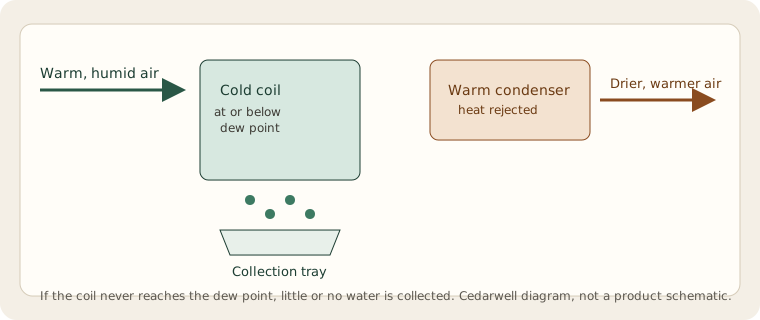
Open project pages and videos often show a Peltier module sandwiched between heat sinks, or a copper coil chilled by ice or a small pump, with a cup underneath. Those demonstrations can be real and still be poor household water sources. A few hundred milliliters on a humid afternoon is a physics lesson. It is not a plan for drinking and sanitation during a week-long outage.
There are also passive ideas: desiccants that take up vapor and then release it when heated, radiative surfaces that get cold at night, and fog nets in the right landscape. Those belong in a separate, lower-yield conversation (and in a later Cedarwell article). Most “DIY AWG” searches are about an electric cooler.
The usual methods people try
| Approach | What it is | What to expect |
|---|---|---|
| Peltier (TEC) plate | A thermoelectric module gets cold on one side and hot on the other when you pass DC current. A fan and heat sink dump the heat. | Simple, compact, often inefficient. Output is usually small unless the air is already warm and humid and the hot side is well cooled. |
| Compressor dehumidifier, used or modified | A machine that already has a compressor, evaporator, fan, and tank. | Can move more air than a toy Peltier. Still not a drinking-water appliance unless you add a food-safe path and treatment. See our dehumidifier article. |
| Chilled-coil or ice-bank loop | Cold water or refrigerant is pumped through a coil in the air stream. | Works on the same dew-point rule. Ice is just a way of storing cold; it does not remove the energy cost of making that cold. |
| Desiccant or solar-passive | A sorbent takes up vapor, then heat drives the water back off to be condensed. | Interesting for off-grid experiments. Yields in published research are often modest and design-sensitive. Not a casual weekend jug-filler. |
Online parts lists often mention a common 12-volt Peltier module, a computer heat sink, and a food-safe cup. Those lists are easy to copy and hard to turn into a reliable liter-per-day device. If a page promises “free water” or a fixed daily gallon figure with no climate data, treat that as marketing, not a specification.
Climate is the main specification
The National Weather Service’s dew-point explanation is the design brief. Relative humidity alone misleads: cold air at 100% relative humidity can hold less vapor than warm air at a lower percentage. A coil has to go below the dew point of the incoming air. In dry or cold weather that dew point may sit out of reach, or you may reach it only by spending a lot of energy.
Our companion page on how much water you can pull from air walks through moisture content and why yield is not a single number. For energy, a 2023 study of commercial atmospheric water generators across the continental United States found that specific energy consumption for refrigeration-based units varied widely with weather — from about 0.02 to 3.64 kWh per liter in the authors’ modeled results — with arid climates demanding more energy per unit of water. A 2026 review cited a dehumidifier-style example that used 1.02 kWh/L at 30°C and 62% relative humidity versus 6.23 kWh/L at 6°C and 80% relative humidity.
A home build will not beat a well-engineered commercial machine just because it was assembled on a workbench. If commercial units already struggle in dry or cold air, a Peltier box in the same weather will not quietly outperform them. See atmospheric water generator electricity cost for how to think about running cost without inventing a bill.
Power, heat, and safety
Cooling is work. The heat you remove from the air, plus the electrical losses in the cooler, has to go somewhere — usually back into the room, which can raise temperature and, in a closed space, eventually dry the air you are trying to harvest. Outdoor or well-ventilated placement, and an honest look at your electrical circuit or battery bank, are part of the project.
Safety is not optional:
- Mains electricity, compressors, and refrigerants are not beginner crafts. If a design uses household AC or sealed refrigerant, get qualified help or do not build it.
- Peltier modules and power supplies get hot. Inadequate heat-sinking is a fire and burn risk, and it also destroys cooling performance.
- Standing water needs to be covered and cleaned. A tray of condensate is a mosquito and biofilm opportunity, just as CDC warns for rain barrels that are not screened or emptied.
Cedarwell is not a wiring manual. If you cannot do the electrical work safely, this is not your project.
Water quality and materials
Even when the physics works, the water has been in contact with a coil, the air in your room or yard, and a tray. Dust, spores, and residues can go with it. That is the same reason we do not treat dehumidifier tanks as drinking fountains.
If you collect water from a homemade unit and intend to drink it:
- Use materials intended for drinking-water contact on every wetted surface you can control.
- Treat the output as raw water. Official emergency pages describe boiling and bleach as microbial tools, and EPA states they will not remove heavy metals or most chemicals.
- A certified filter only helps with the contaminants it is certified to reduce. Match treatment to the risk; do not assume “it came from air.”
- Keep this water separate from your stored bottled or municipal reserve, in the same spirit as CDC’s warning not to mix untreated rainwater into treated water.
Paid DIY guides, including Water Freedom System
Search results for homemade AWGs include free videos, open hardware pages, and paid digital plans sold through platforms such as ClickBank. Water Freedom System is one of those paid guides. Our Water Freedom System review describes what the offer is, the 60-day refund stated on the vendor’s refund page, and the physical limits above. Cedarwell has not purchased, built, or tested that product, and we do not repeat unverified daily-output claims.
Other similarly marketed plans exist (SmartWaterBox is often mentioned in the same niche). A second brand name does not change the dew point. If you buy any guide, you are buying documents. Parts, filters, electricity, and safe assembly are extra. A stated refund window, if it exists, usually covers the document purchase, not the hardware.
Disclosure: Cedarwell may earn a commission if you buy through the link below, at no extra cost to you. This is a review page. We have not built or tested the product ourselves. Full affiliate disclosure.
The link goes to the vendor’s ClickBank offer page (vendor id waterfs). Cedarwell is not the seller. Confirm the current price, terms, and any upsells on the checkout form before you pay.
If you live in a warm, humid climate, have spare power, and want a measured experiment on top of a proper stored-water reserve, a carefully chosen DIY path can be an education. If you need water in a dry or cold season, or you need volume tomorrow morning, spend the first effort on stored water and on understanding the other options.
A practical test plan, if you do build something, is simple and unglamorous: a thermometer and humidity reading (or a weather-station dew point), a kill-a-watt style meter or inverter log, a measuring jug, and a notebook. Record those four things daily for weeks, not hours. That log will tell you more than a sales page. Cedarwell would need the same kind of log before we would ever claim a gallons-per-day result, and we do not have one.
Frequently asked questions
Can I make an atmospheric water generator without electricity?
Passive ideas exist — desiccants, night-sky cooling, fog nets — but they are not a drop-in replacement for a powered coil, and their yield is highly site-specific. Autocomplete interest in “no electricity” builds is real; a later Cedarwell guide will take that branch separately rather than over-promise here.
How much water can a homemade AWG produce in a day?
There is no honest single number. Output depends on temperature, humidity (better: dew point), airflow, coil temperature, and run time. Cedarwell has no test log of our own and will not invent gallons per day.
Is DIY AWG water safe to drink straight from the tray?
No. Treat it as raw water. Official microbial treatments do not automatically remove metals or chemicals, and a homemade coil is not a certified drinking-water system.
Is a dehumidifier already a DIY atmospheric water generator?
It already condenses water. It is not designed or maintained as a drinking-water appliance. Read the dehumidifier article before you treat a bucket as a cistern.
Sources
- US National Weather Service, “Dew Point vs Humidity”: weather.gov/arx/why_dewpoint_vs_humidity.
- “Temporal and spatial variability of energy intensity for atmospheric water generators,” Environmental Research: Infrastructure and Sustainability, 2023, DOI 10.1088/2634-4505/accec9.
- Zanj et al., “Atmospheric water harvesting: technologies, materials, and pathways toward scalable and sustainable deployment,” including the dehumidifier energy example: Flinders open PDF.
- US EPA, “Emergency Disinfection of Drinking Water”: epa.gov emergency disinfection.
- CDC, “How to Create an Emergency Water Supply,” 27 June 2025: cdc.gov emergency water supply.
- CDC, “Collecting Rainwater and Your Health: An Overview,” on first-flush, screening, and not mixing untreated water into treated supplies: cdc.gov rainwater.
- Vendor refund page for Water Freedom System: waterfreedomsystem.com/refunds.html.